Beverage Temperature and Co2 Retention: A Complete Guide for Carbonated Beverages
Introduction
In carbonated soft drinks (CSDs), beverage temperature is one of the most important factors affecting carbonation, filling performance, package pressure, taste, and shelf stability. Understanding Beverage Temperature and Co2 Retention helps beverage plants maintain consistent carbonation and reduce carbon dioxide (CO2) losses during production and handling. As product temperature decreases, CO2 becomes more soluble in the beverage, allowing the finished drink to retain more dissolved gas. When temperature rises, CO2 becomes less soluble and can escape more easily, which may reduce gas volume (GV) and create a flatter sensory experience. This guide from Food Beverage World explains how temperature influences CO2 retention, why cold product is preferred during filling, which temperatures generally support better retention, and what quality checks production and quality teams should monitor to maintain consistent beverage quality.
Beverage Temperature and Co2 Retention in Carbonated Soft Drinks
Beverage Temperature and Co2 Retention are closely connected because temperature affects a liquid’s ability to hold dissolved CO2. During carbonation, CO2 is dissolved under pressure. A cold product holds CO2 more effectively, while a warmer product releases it more easily.
Why Beverage Temperature and Co2 Retention Matter
Carbonation contributes to mouthfeel, freshness, aroma release, and overall product character. Excessive CO2 loss can make a beverage taste flat or less refreshing.
The Basic Relationship Between Temperature and CO2
Lower product temperature generally supports higher CO2 retention, while higher temperature increases the risk of CO2 loss. However, temperature is not the only factor. Pressure, agitation, product composition, equipment condition, and package design also affect carbonation. Quality teams should therefore evaluate temperature together with pressure and Gas Volume (GV).
How Temperature Affects Carbonation
Temperature Affects Carbonation: At lower temperatures, a beverage can hold more dissolved CO2 under the same pressure. As temperature increases, dissolved CO2 becomes less stable and can come out of solution. A warm product may therefore release gas rapidly, producing bubbles and foam.
Cold Product and Better Carbonation
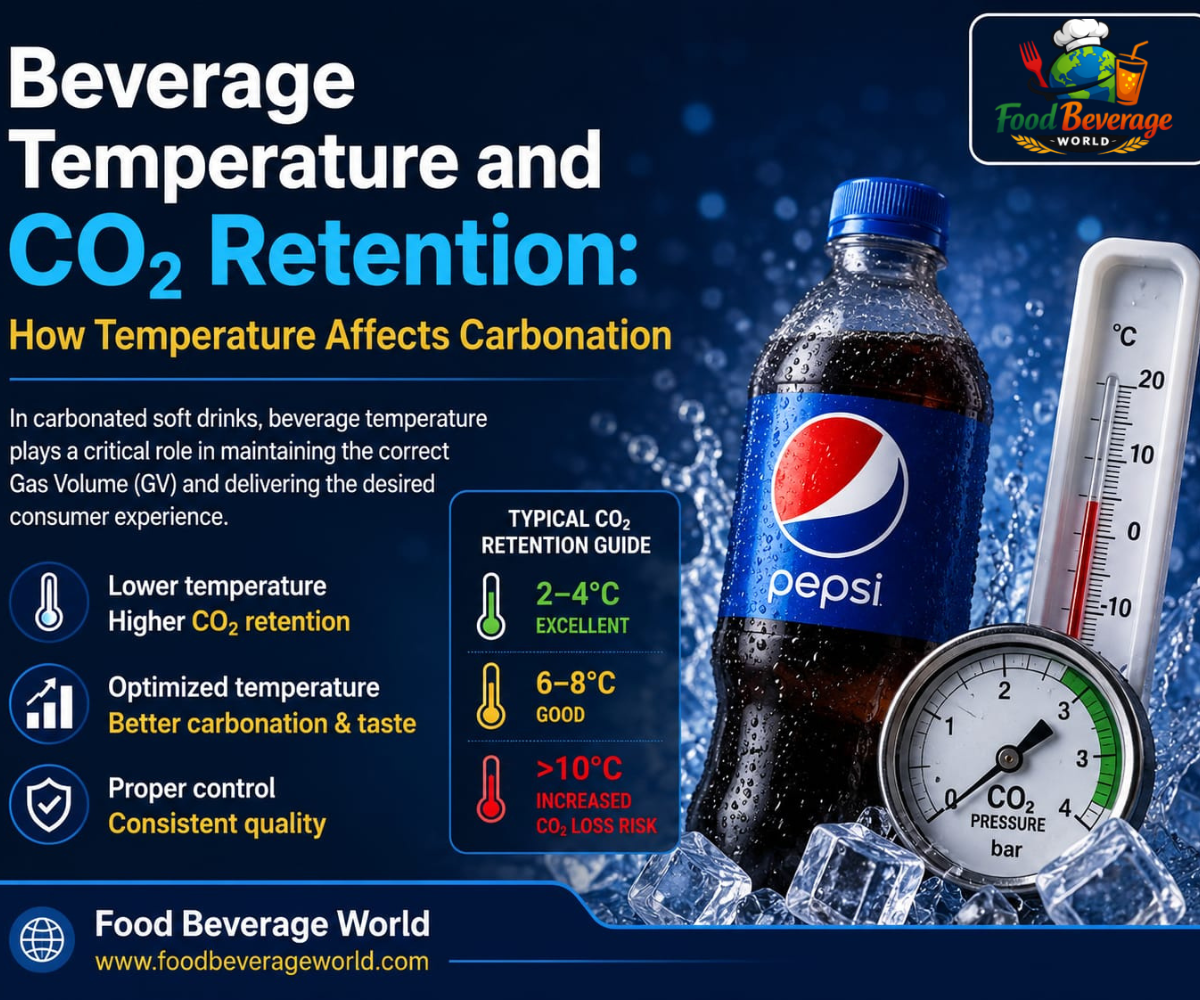
Cold product generally provides better carbonation retention. A temperature around 2–4°C is often favorable for strong CO2 retention in many beverage processes, although the actual target must come from the product specification and equipment design.
What Happens When Product Gets Warm?
As product temperature rises, CO2-loss risk increases. The infographic provides an indicative guide: 6–8°C is shown as “good,” while temperatures above 10°C are shown as increasing the risk of CO2 loss. These values are not universal limits; each beverage and filling system should have an approved operating range.
Beverage Temperature and Co2 Retention During Filling
The filler is a sensitive point for carbonation control. Product may leave the carbonator at an acceptable temperature and GV, but conditions can change before it reaches the filling valve.
Critical Temperature and GV Checks
A practical quality-control program should monitor:
- Beverage temperature before the filler.
- Carbonator outlet temperature.
- GV at the filler.
- GV in the finished product.
Why GV Is Important
Gas Volume (GV) is commonly used to describe dissolved CO2 in a carbonated beverage under defined test conditions. Required GV depends on beverage type, brand specification, package format, and process design.
A stable GV result indicates consistent carbonation control. A sudden GV drop can indicate temperature or pressure problems, leakage, incorrect carbonation settings, or excessive CO2 release during handling.
Common Causes of CO2 Loss in a Beverage Plant
Temperature is important, but other conditions can reduce carbonation. Common causes include insufficient carbonation pressure, incorrect carbonator settings, high product temperature, excessive agitation, leaks, poor sealing, long residence time, and unsuitable operating procedures.
How Operators Can Reduce CO2 Loss
Operators can reduce losses by maintaining the approved product temperature, controlling pressure, minimizing unnecessary agitation, checking for leaks, and avoiding excessive delays between carbonation and filling.
Production teams should keep cooling systems, carbonators, pipes, valves, and filler components in good condition. Preventive maintenance helps prevent equipment problems from becoming carbonation variation.
Temperature Control Is a Team Responsibility
Quality Checks for Better Beverage Temperature and Co2 Retention
A good monitoring system should define sampling frequency, acceptable limits, test methods, corrective actions, and records. Temperature instruments and carbonation equipment should be verified or calibrated according to the plant quality system.
Corrective Actions When CO2 Retention Is Low
In practical production, temperature should be checked at consistent locations and times so results can be compared correctly. Operators should avoid taking a reading immediately after line disturbance unless the procedure requires it. Samples for GV testing should be handled according to laboratory method because shaking, warming, or delayed testing can change the measured result. When results approach a limit, the team should increase attention to cooling performance, pressure stability, filler operation, and product transfer. Consistent records allow supervisors to compare shifts, identify trends, and confirm whether corrective actions are effective. This approach supports preventive control rather than waiting for customer complaints or failures.
Practical Rule for Beverage Plants
Keep product within its approved cold-temperature range, control pressure, minimize unnecessary disturbance, and verify GV at critical points. The exact temperature and carbonation target should come from the product specification and validated process, not a generic number.
Conclusion: Beverage Temperature and Co2 Retention
Beverage Temperature and Co2 Retention are fundamental quality factors in carbonated beverage manufacturing. Lower temperatures generally help retain dissolved CO2, while higher temperatures increase the potential for gas release, foaming, lower GV, and a flatter beverage.
Food Beverage World emphasizes a simple quality principle: cold, controlled, and consistently monitored product supports better carbonation performance. Understanding temperature and CO2 solubility helps beverage professionals improve process stability and deliver a consistent consumer experience.
Frequently Asked Questions
1: What is Beverage Temperature and Co2 Retention?
Beverage Temperature and Co2 Retention describes the relationship between product temperature and the ability of a carbonated drink to keep dissolved CO2. Lower temperatures generally improve CO2 solubility, while warmer temperatures increase CO2-loss risk.
2: Why does Beverage Temperature and Co2 Retention affect carbonation?
Beverage Temperature and Co2 Retention affect carbonation because CO2 is more soluble at lower temperatures. Warm product can release CO2 more easily, causing lower GV, increased foaming, and a flatter taste.
3: What temperature is best for Beverage Temperature and Co2 Retention?
For many carbonated beverage processes, approximately 2–4°C can support excellent CO2 retention, but this is not universal. The correct Beverage Temperature and Co2 Retention target should be established by the product specification and validated process.
4: How can a plant improve Beverage Temperature and Co2 Retention?
A plant can improve Beverage Temperature and Co2 Retention by maintaining approved cold-product conditions, controlling carbonation pressure, reducing agitation, preventing leaks, minimizing delays, and monitoring GV at critical points.
5: Which tests support Beverage Temperature and Co2 Retention control?
Temperature measurement and GV testing are key checks for Beverage Temperature and Co2 Retention. Plants should monitor temperature before the filler, carbonator outlet temperature, GV at the filler, and GV in the finished product using verified methods.