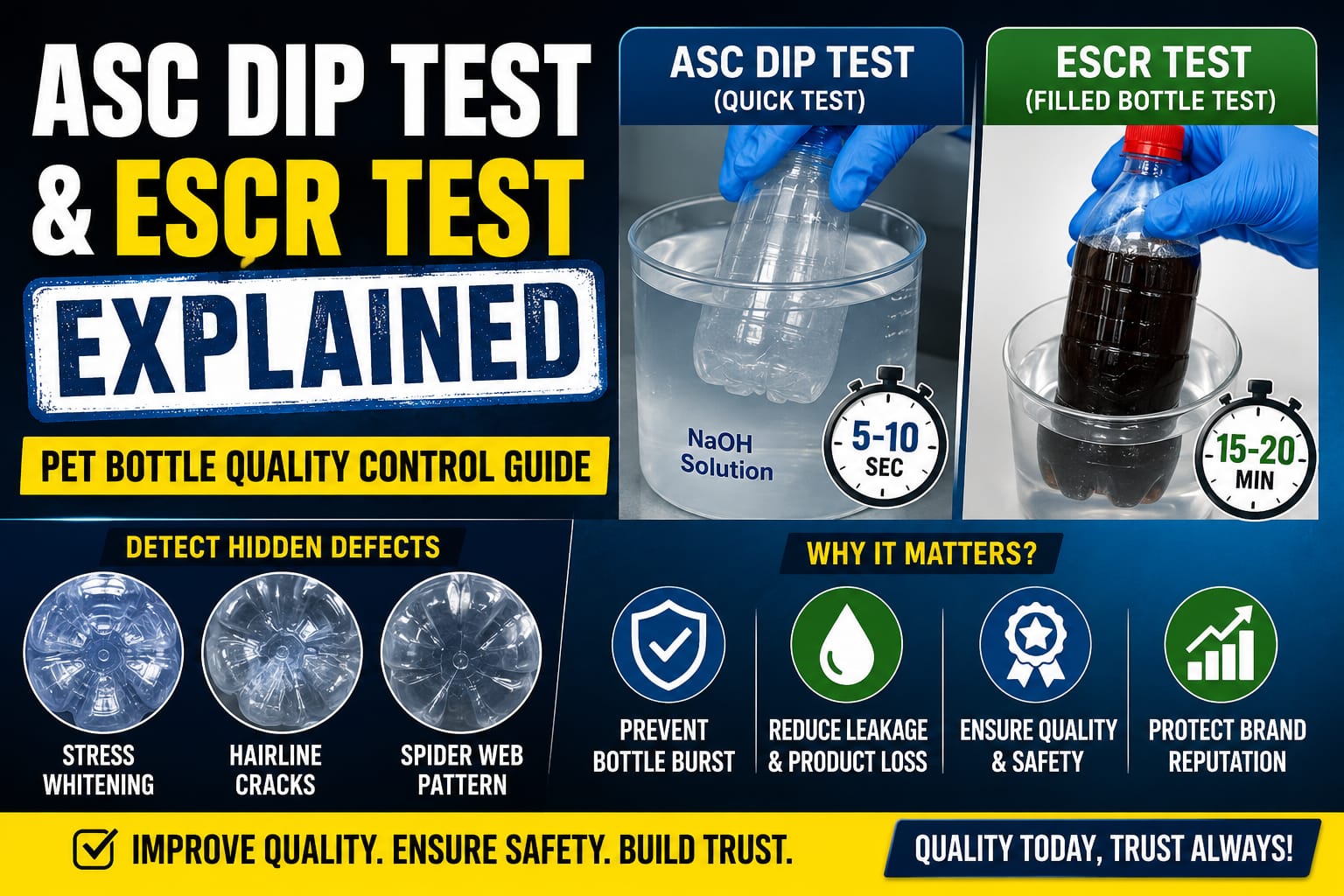
ASC Dip Test & ESCR Test Explained (PET Bottle Quality Control Guide)
ASC in industry is commonly referred to as “Air Seal Check” or, in some cases, “Base Stress Crack Test” (the name may vary depending on the company or plant).
What is the Purpose of the ASC Test?
The main purpose of this test is to check for any defects in the base (bottom) of the bottle, such as:
- Hairline cracks
- Stress marks
- Weak structure
In simple terms, it verifies whether the bottle can withstand pressure or not.
Why is the ASC Test Important?
In the beverage industry, especially for carbonated drinks (soft drinks), there is internal pressure inside the bottle. Therefore:
For Safety:
- A weak base can cause the bottle to burst.
To Prevent Product Loss:
- Leakage or breakage can lead to losses.
For Quality Control:
- Only strong and standard bottles are allowed on the production line.
For Brand Image:
- A defective bottle in the market can damage the company’s reputation.
How Does the ASC Test Help?
This test highlights stress or defects in the bottle base so that:
- Weak bottles are rejected immediately
- Accidents on the line are avoided
- No issues occur during filling and capping
In Simple Words:
- ASC Test = A test to check the strength and defects of the bottle’s bottom part
ASC Dip Test / Stress Crack Test (Solution Method)
Which Solution is Used?
In industry, an alkaline solution is commonly used, such as:
- Caustic Soda (NaOH) solution
- Sometimes NaOH + surfactant (detergent) mixture
This solution highlights weak or stressed areas in PET bottles.
Why is This Solution Used?
This solution:
- Reveals residual stress in the bottle
- Makes weak areas show cracks or whitening quickly
- Turns invisible defects into visible ones
Step-by-Step Method (Dip Method)
Solution Preparation
- Typically, 1% to 2% NaOH solution is prepared
- Water is at room temperature (~25–30°C) or slightly warm
Bottle Preparation
- Use an empty, clean, and dry bottle
Dipping Process
- Dip only the base (bottom) of the bottle into the solution
- Do not immerse the entire bottle
Time (Important)
- Standard: 5–10 seconds
- In some plants: 15–30 seconds (for higher sensitivity)
Observation
After removing the bottle, observe immediately:
- If OK → no change
If defective →
- Stress whitening (white lines)
- Hairline cracks
- Spider web patterns
Safety (Very Important)
Since NaOH is caustic:
- Wear gloves
- Use eye protection
- Avoid skin contact
Reject Criteria
Reject the bottle immediately if:
- Whitening appears
- Cracks develop
In Simple Words:
- In the dip test, we immerse the bottle base in a caustic solution to reveal hidden weaknesses.
Can We Test a Filled Bottle?
- Yes, but this is NOT the ASC dip test.
This is a different test called:
- Environmental Stress Crack Resistance (ESCR) Test
or
- Filled Bottle Stress Test
Why Test Filled Bottles?
When the bottle is filled (especially with carbonated drinks):
- There is internal pressure inside
- Chemical (NaOH) is applied externally
This creates dual stress (internal + external), which simulates real-life conditions.
Is Your Method (15–20 Minutes) Correct?
- Yes, your method is correct — but the purpose is different
Filled Bottle Test:
- The bottle is not empty
- The base is dipped directly into the solution
- 15–20 minutes is standard
During this time, check for:
- Leakage
- Crack development
- Base failure
What is Standard ASC (Quick Test)?
- Uses an empty & dry bottle
- 5–10 seconds dip
- Used for quick screening
Difference Between Both Methods
Feature Quick ASC Test Filled Bottle Test
Bottle Empty Filled:
- Time 5–10 sec 15–20 min
Purpose: Surface stress detection, real-condition failure check. Sensitivity Lower Higher (practical)
Important Point
- If you want ASC results → use an empty bottle
- If you want an actual performance check → use the filled bottle method
In Simple Words:
- Your 15–20 minute test is not wrong
- In fact, it is a more practical and stronger test
- But it should not be called the ASC test.
- The correct term is: Filled Bottle Stress Test / ESCR Test