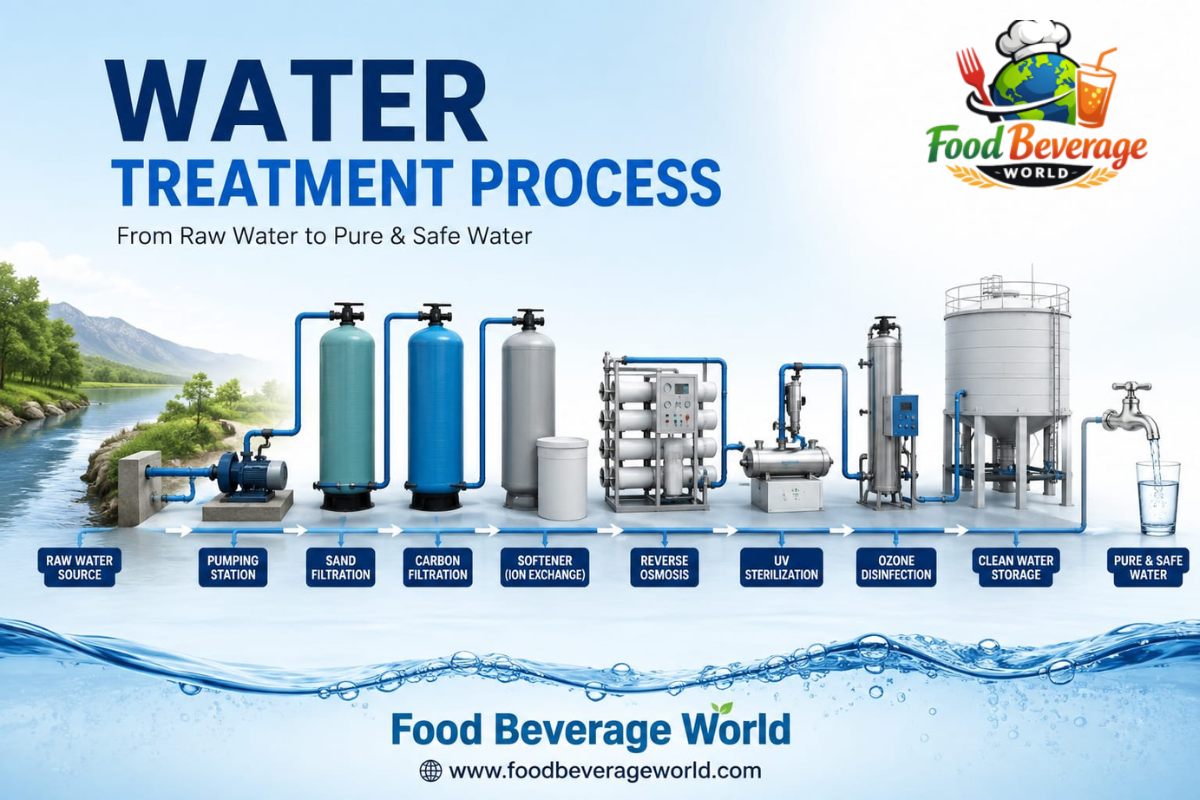
Introduction
The water treatment process is the process of removing physical, chemical, and microbiological impurities from raw water to make it safe and suitable for its intended use, especially beverage production.
Explain impurities in raw water
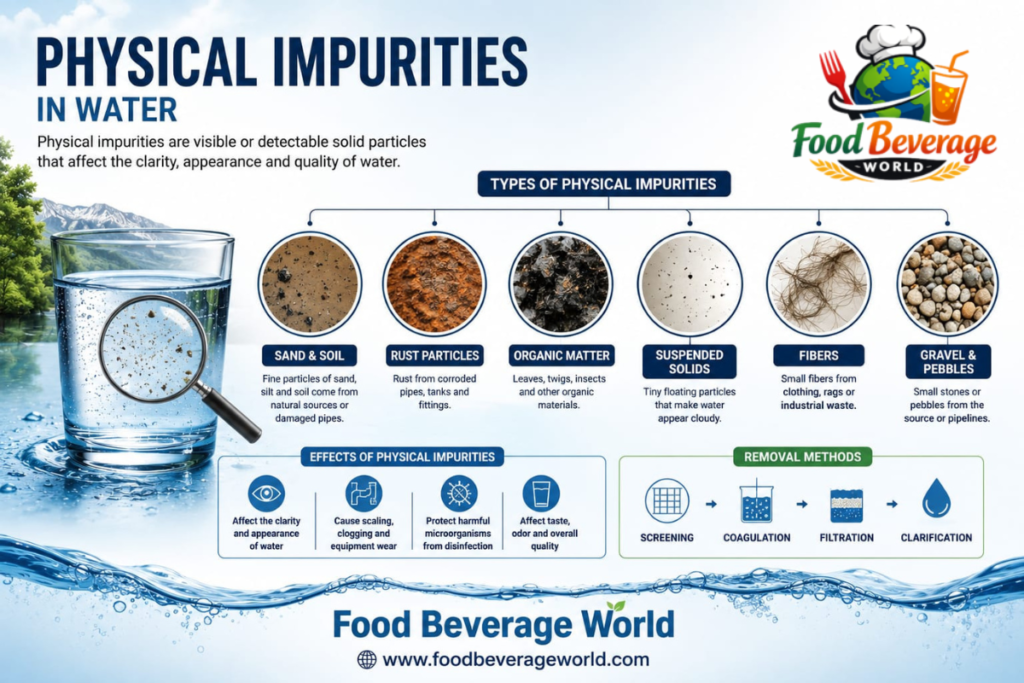
Physical Impurities
Physical impurities are unwanted physical particles or suspended matter present in water. They can affect the appearance, clarity, and turbidity of water.
Examples:
- Sand
- Mud
- Dust
- Silt
- Suspended Solids
- Rust Particles
- Organic Particles
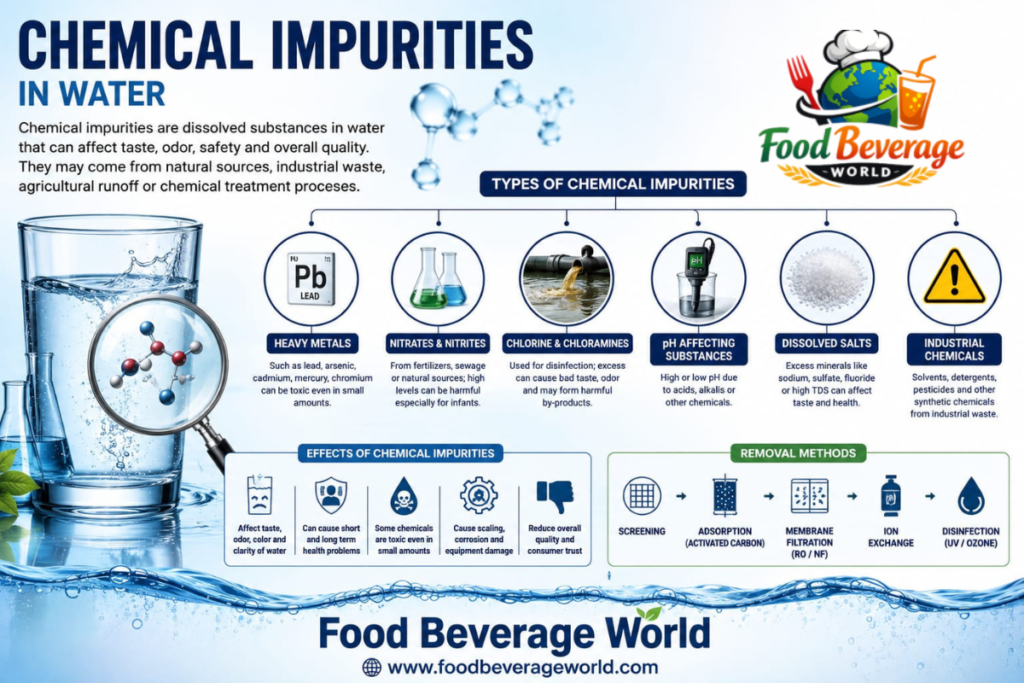
Chemical Impurities
Chemical impurities are dissolved chemicals, minerals, salts, or other unwanted substances present in water. They are usually not visible to the naked eye and can affect water quality, taste, hardness, and TDS.
Examples:
- Calcium
- Magnesium
- Iron
- Manganese
- Chloride
- Sulphate
- Nitrate
- Dissolved Salts
- High TDS
- Heavy Metals
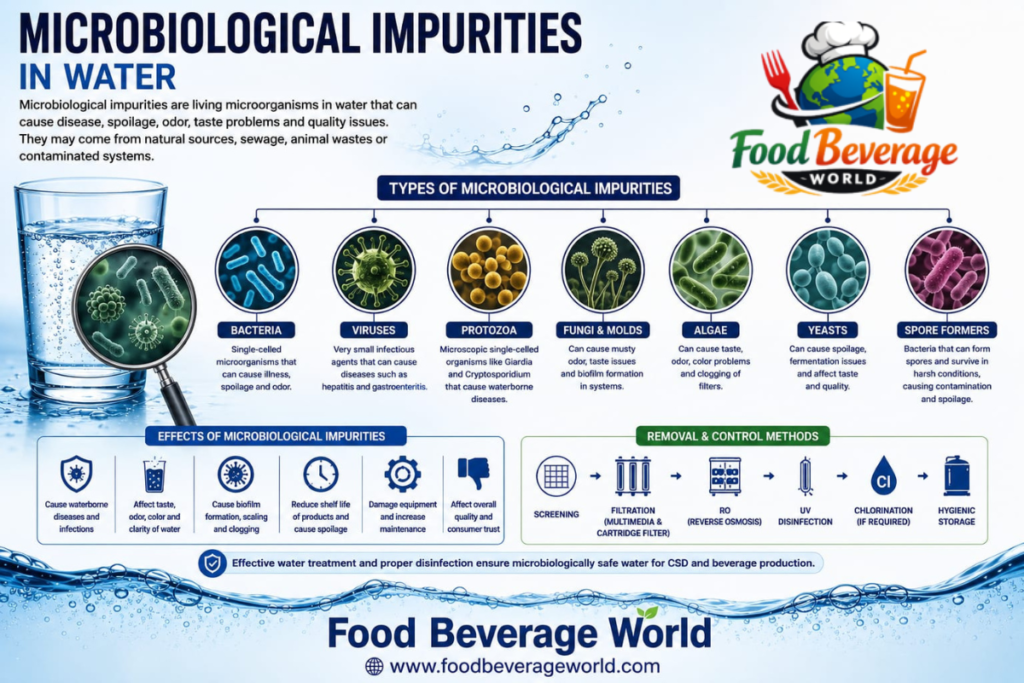
Microbiological Impurities
Microbiological impurities are harmful or unwanted microorganisms present in water that can make water unsafe for drinking or beverage production.
Examples:
- Bacteria
- Viruses
- Protozoa
- Yeasts
- Molds
- Coliforms
- E. coli
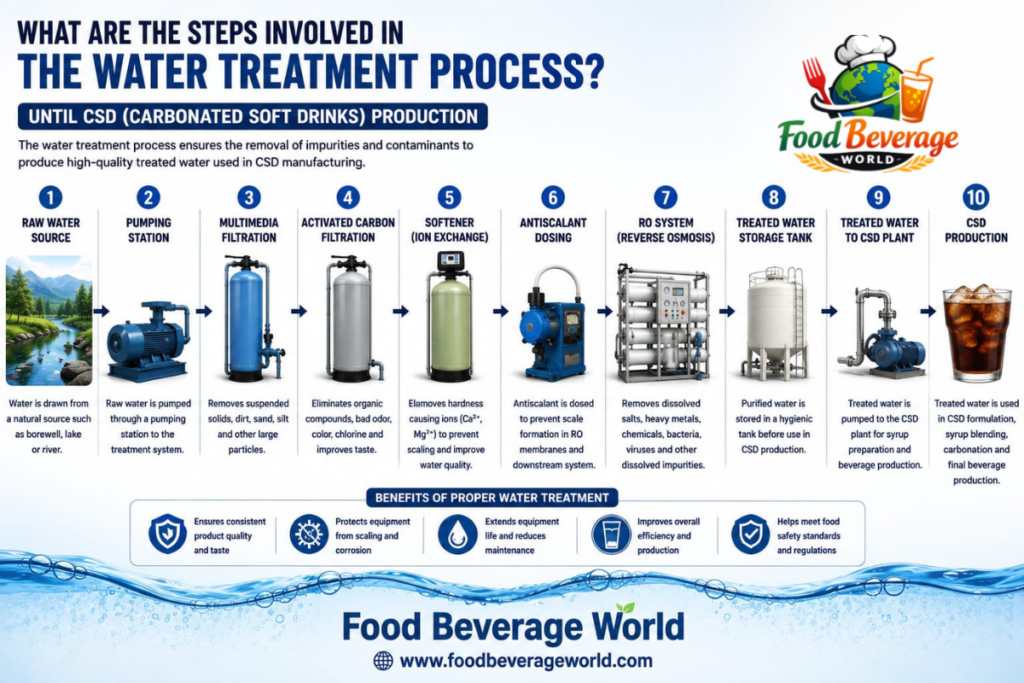
What are the steps involved in the water treatment process?
Raw Water and Reaction Tank
The process begins with Raw Water entering the Reaction Tank. Chlorine (Cl₂) is added at approximately 4–5 ppm for initial disinfection and to control microbiological contamination in the raw water.
Sand Filter
After the reaction tank, the water passes through the Sand Filter. The sand filter removes suspended particles, dirt, mud, sand, and other physical impurities from the water, helping reduce turbidity.
Carbon Polisher
After sand filtration, the water passes through the Carbon Polisher. Activated carbon helps remove chlorine, unwanted taste, odor, and certain organic impurities from the water.
Water Polisher and RO Membrane
The water then passes through a Water Polisher and enters the RO (Reverse Osmosis) Membrane, which is approximately 0.0001 micron. The RO membrane removes dissolved salts, minerals, and other dissolved impurities and significantly reduces TDS.
RO Tank and Carbon Polisher
After RO treatment, the treated water is collected in the RO Tank. According to the process shown, chlorine is maintained at approximately 2–3 ppm in the RO tank. The water then passes through another Carbon Polisher to control residual chlorine and improve the water quality before the final polishing stage.
Final Water Polisher and CSD
Finally, the water passes through a Water Polisher (1.0 micron) for final filtration. After this final polishing step, the treated water is supplied to the CSD (Carbonated Soft Drink) production process for beverage manufacturing.
FAQ: What are the steps involved in the water treatment process?
Why is Chlorine Added to Raw Water?
Chlorine is added to raw water for disinfection and to control microorganisms such as bacteria.
Is chlorine dangerous for human consumption?
Chlorine can be harmful at high concentrations, but it is safe when used within controlled limits. In water treatment, chlorine is added for disinfection, and the residual chlorine is later removed or controlled before the water is used for beverage production.
What is the purpose of a sand filter in water treatment?
A sand filter removes suspended particles, dirt, sand, mud, and other physical impurities from water. It helps reduce turbidity and improves the clarity of the water before the next treatment step.
What is turbidity in the water treatment Process?
Turbidity is the cloudiness or haziness of water caused by suspended particles such as mud, sand, dust, and other small particles. High turbidity means the water is less clear.
What is the purpose of a carbon filter in a water treatment Process?
A carbon filter uses activated carbon to remove chlorine, bad taste, bad odor, and some organic impurities from water. It is important because it improves the quality and taste of water before the next treatment stage.
What is a water polisher, and why is it used in the water treatment Process?
A water polisher is a fine filtration unit used to remove very small particles from water. It is used to improve water clarity and quality before the next treatment stage or beverage production.
What is an RO membrane, and why is it used in the water treatment Process?
An RO (Reverse Osmosis) membrane is a very fine membrane that removes dissolved salts, minerals, and other impurities from water. It is used to reduce TDS and produce high-quality purified water for beverage production.
What is the pore size of an RO membrane?
An RO membrane has extremely small pores, typically around 0.0001 micron (0.1 nanometer). Because of this very fine structure, it can remove dissolved salts, minerals, and many other impurities from water.
Why is chlorine added to the RO tank after RO treatment?
Chlorine is added to the RO tank to control and prevent microbiological growth during water storage. It helps maintain the microbiological quality of the treated water until the next treatment stage.
Why is chlorine added to the RO tank after RO treatment?
Chlorine is added to the RO tank to control and prevent microbiological growth during water storage. It helps maintain the microbiological quality of the treated water until the next treatment stage.
Why is water passed through a water polisher after the RO tank?
The water polisher provides final fine filtration before the water goes to beverage production. It removes any remaining fine particles and helps improve the clarity and quality of the treated water.
Is very low TDS water safe for human consumption?
Very low TDS water can be safe if it is properly treated and meets drinking-water quality standards. However, RO can remove most dissolved minerals, so for drinking water, the final water may need appropriate mineral balance or blending according to the required specification.
Mineral Water Preparation Process
Water Polisher
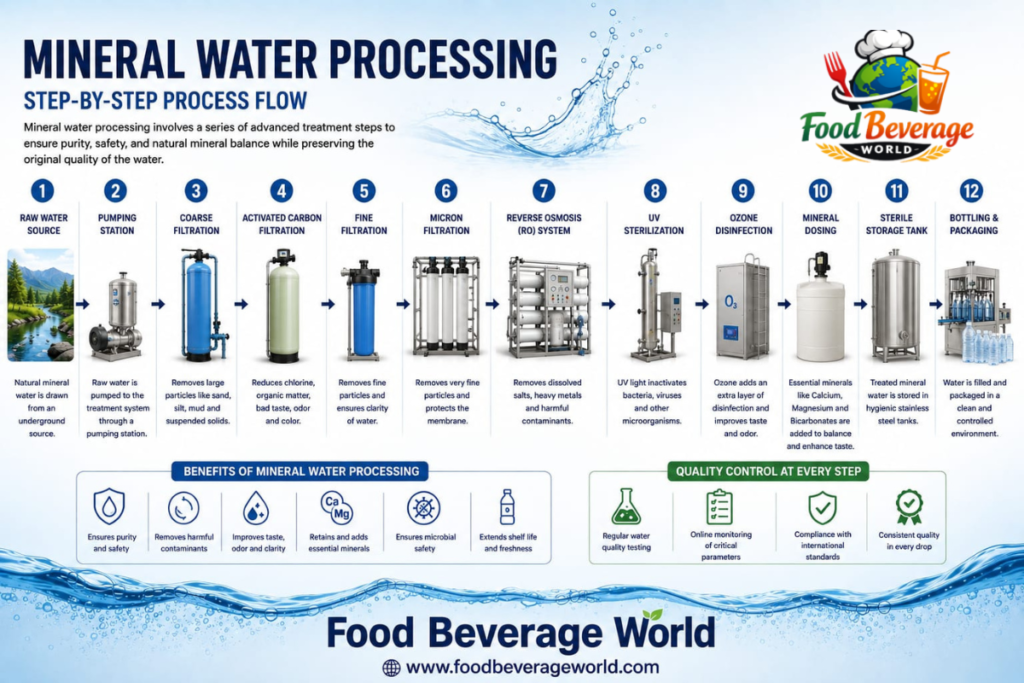
RO-treated water is first passed through a Water Polisher to remove any remaining fine suspended particles and improve water clarity before mineral dosing.
Mineral Dosing
After polishing, required minerals are added to the RO water in controlled quantities according to the approved mineral water formula.
Commonly used minerals include:
- CaCl₂ (Calcium Chloride): Provides Calcium.
- MgSO₄ (Magnesium Sulphate): Provides Magnesium.
- NaHCO₃ (Sodium Bicarbonate): Provides Sodium and Bicarbonate.
The exact quantity is calculated according to the required final specifications for Calcium, Magnesium, Sodium, Bicarbonate, TDS, and pH.
The exact dosing quantity cannot be fixed universally because it depends on the required specification, chemical purity, and whether the chemical is in anhydrous or hydrated form.
5 Micron Water Polisher
After mineral dosing, the water passes through a 5 µm filter.
Its purpose is to remove relatively larger suspended particles and any undissolved material, while also reducing the load on the finer filters.
1 Micron Water Polisher
The water then passes through a 1 µm filter.
This provides finer filtration and removes smaller suspended particles that may remain after the 5 µm filtration stage.
0.2 Micron Water Polisher
The water is then passed through a 0.2 µm filter.
This provides very fine filtration and can help remove many bacteria and very fine particles. However, it should not be considered complete sterilization by itself.
UV Treatment
After fine filtration, the water passes through a UV Light system.
The main purpose of UV treatment is to inactivate microorganisms. UV light damages the genetic material of microorganisms and prevents them from reproducing.
Ozonation
Finally, Ozone (O₃) is introduced into the water. Ozone is a strong oxidizing agent used for final disinfection and microbiological control. The ozone dose should be controlled according to the validated plant process, water quality, contact time, and required ozone residual.
There is no single universal ozone dose for every plant; the correct dose should be established through process validation.
Ready for Mineral Water Filling
After completing all these treatment stages, the water is tested to ensure that it meets the required physical, chemical, and microbiological specifications.
Once it meets the required specifications, it is ready for Mineral Water Filling.
Complete Process:
RO Water
↓
Water Polisher
↓
Mineral Dosing (CaCl₂ + MgSO₄ + NaHCO₃)
↓
5 µm Filtration
↓
1 µm Filtration
↓
0.2 µm Filtration
↓
UV Treatment
↓
Ozonation
↓
Ready for Mineral Water Filling
FAQ: Mineral Water Preparation Process
What are the causes of high or low pH in mineral water, and how can it be corrected?
Low or high pH can be caused by incorrect mineral dosing, especially the balance of bicarbonate, calcium, and magnesium, or by changes in the source/RO water. pH can be corrected by adjusting mineral dosing or by blending with properly treated water, in accordance with the approved specification.
What are the causes of low or high TDS in mineral water, and how can it be corrected?
Low TDS can result from insufficient mineral dosing, while high TDS can result from excessive dosing or high TDS in the RO water. It can be corrected by adjusting the mineral dosing according to the approved specification and checking the RO water quality.
What are the causes of low or high hardness in mineral water, and how can it be corrected?
Low hardness can be caused by insufficient calcium and magnesium dosing, while high hardness can result from excessive calcium or magnesium dosing. It can be corrected by adjusting the mineral dosing according to the required specification.
What are the causes of low or high magnesium in mineral water, and how can it be corrected?
Low magnesium can be caused by insufficient MgSO₄ dosing, while high magnesium can result from excessive MgSO₄ dosing. It can be corrected by adjusting the MgSO₄ dosing according to the required specification.
What are the causes of low or high calcium in mineral water, and how can it be corrected?
Low calcium can be caused by insufficient CaCl₂ dosing, while high calcium can result from excessive CaCl₂ dosing. It can be corrected by adjusting the CaCl₂ dosing according to the required specification.
Why is mineral water passed through a UV light, and is UV treatment necessary?
UV treatment is used to inactivate microorganisms such as bacteria and viruses and provide an additional level of microbiological safety. Its necessity depends on the plant’s validated process and water-quality requirements, but it is commonly used as a final disinfection barrier.
Why is ozone added to mineral water, and is ozonation necessary?
Ozone is added to control microorganisms and provide final disinfection before filling. Ozonation is commonly used in bottled-water plants, but whether it is necessary depends on the plant’s validated process, water-quality requirements, and applicable standards.
What is the role of UV light in water treatment?
UV light is used to inactivate microorganisms such as bacteria and viruses by damaging their genetic material. It works physically and does not add any chemicals to the water.
What is the role of ozone in water treatment?
Ozone is used as a chemical disinfectant to control microorganisms and provide final disinfection. It is a strong oxidizing agent and can also help control taste, odor, and some organic impurities.
Simple Difference
UV → Physical disinfection, no chemical residual
Ozone → Chemical oxidation + disinfection, can provide residual protection for a limited time