Henry’s Law
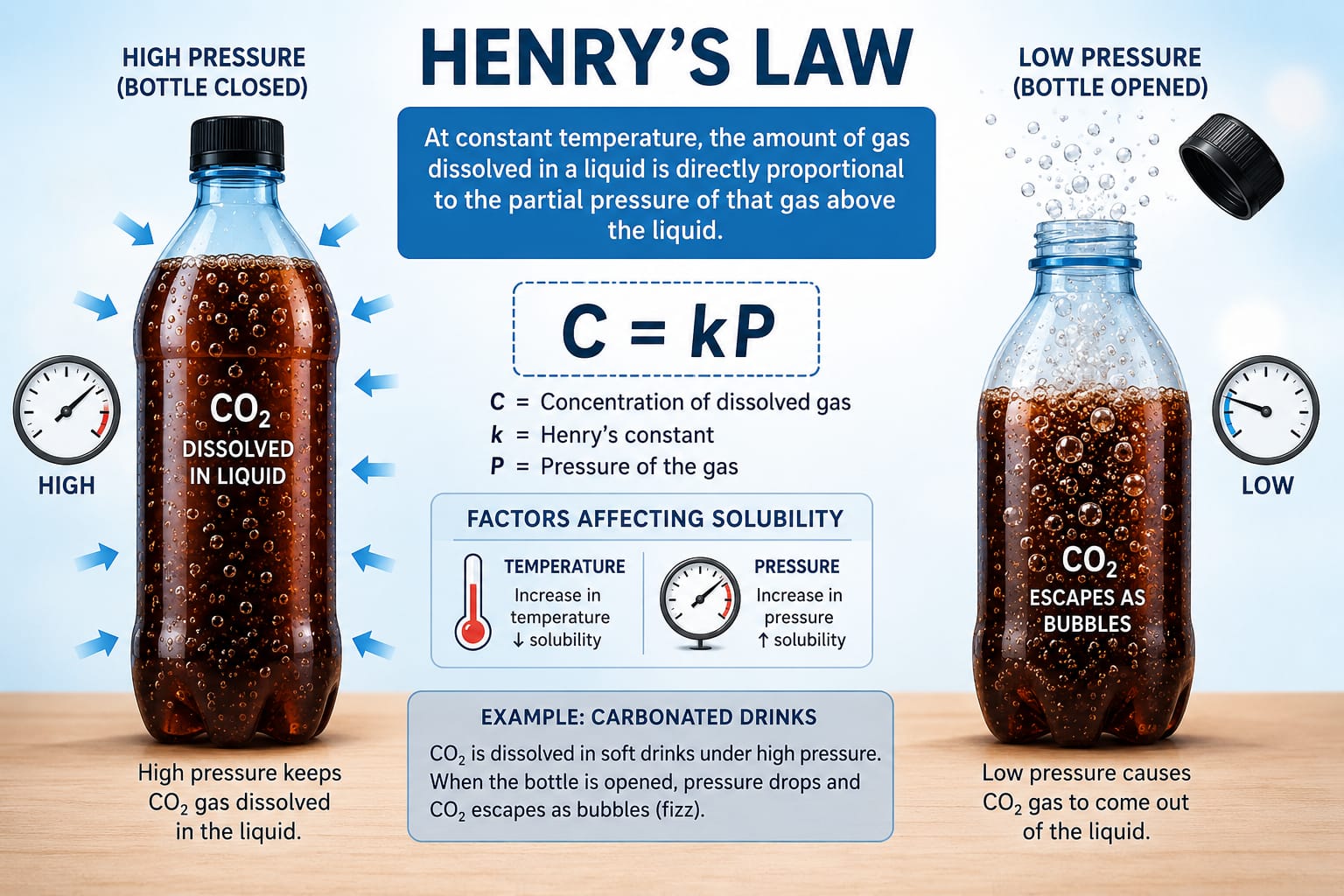
Henry’s Law explains the relationship between a gas and a liquid. The amount of gas dissolved in a liquid is directly proportional to the pressure of that gas above the liquid, at constant temperature.
In simple words:
- Higher pressure → More gas dissolves
- Lower pressure → Gas escapes from the liquid
This principle is called Henry’s Law.
Henry’s Law Formula
- C = kP
Where:
- C = Concentration of dissolved gas
- k = Henry’s constant
- P = Pressure of the gas
This means:
If pressure increases, more gas dissolves in the liquid.
Soft Drink Bottle
When a soft drink bottle is closed:
- The CO₂ gas is under high pressure
- Because of high pressure, CO₂ remains dissolved in the drink
When the bottle is opened:
- Pressure suddenly decreases
- CO₂ starts escaping
- Bubbles and fizz appear
This is a perfect example of Henry’s Law.
Henry’s Law Applications in the Beverage Industry
Carbonation Control
Carbonation:
CO₂ is dissolved into beverages under controlled pressure to achieve the correct Gas Volume (GV).
If pressure is too low:
- Less CO₂ dissolves
- Drink tastes flat
- If pressure is too high:
- Over-carbonation
- Filling problems may occur
Filling Temperature
- As temperature increases, gas solubility decreases.
- That is why beverages are cooled before filling.
Example:
- At 4°C, more CO₂ dissolves
- At 25°C, less CO₂ dissolves
That is why cold drinks hold carbonation better.
Bottle Opening and Gas Loss
When the cap is opened:
- Pressure drops
- Dissolved CO₂ escapes
- Fizz and foam are produced
- This is Henry’s Law in action.
Daily Life Examples
Why does a cold drink stay fizzy longer?
- Because low temperature allows more CO₂ to remain dissolved.
Why does a warm soda foam more when opened?
- Because warm liquid cannot hold as much dissolved gas, so CO₂ escapes quickly.
Factors Affecting Henry’s Law
Pressure
- Higher pressure → More gas dissolves
Temperature
- Higher temperature → Less gas dissolves
Type of Gas
Different gases dissolve differently.
For example:
- CO₂ dissolves well in water
- Oxygen dissolves less
Interview Question Answer
Q: What is Henry’s Law?
Answer:
Henry’s Law states that the amount of gas dissolved in a liquid is directly proportional to the partial pressure of that gas above the liquid, at constant temperature.
Easy Way to Remember
“The higher the pressure, the more gas stays trapped in the liquid.”
This is the basic principle behind:
- Beverage carbonation
- Gas Volume (GV)
- Filler pressure control
- Bottle fizz formation