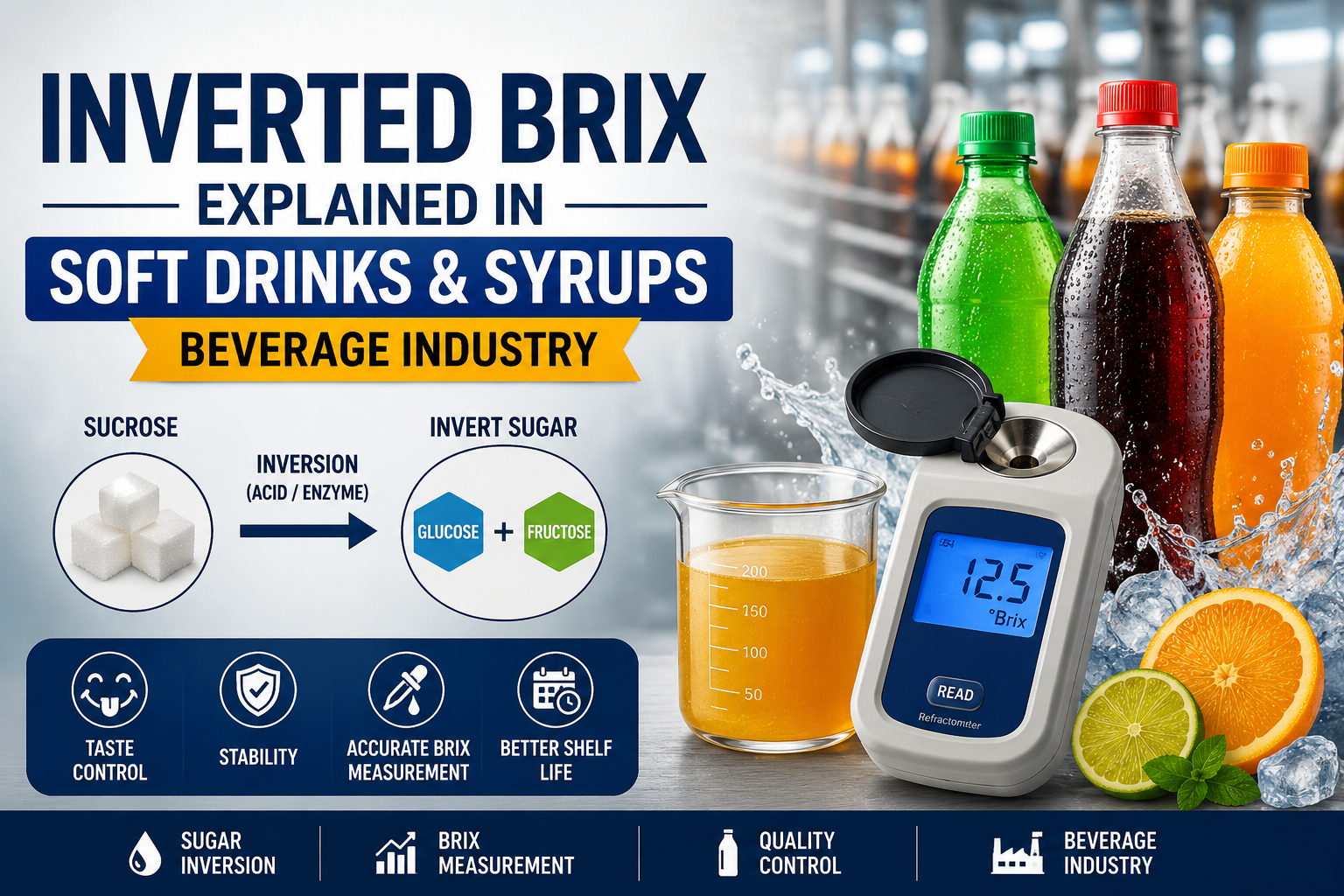
Inverted Brix Explained in Soft Drinks & SyrupIn the beverage industry, Inverted Brix is a term commonly used when the sugar present in a drink — especially Sucrose (table sugar) — is broken down with the help of acid or enzymes.
In simple words:
- Normal sugar = Sucrose
When sucrose breaks down, it converts into two sugars:
- Glucose
- Fructose
This process is called:
- Inversion of Sugar
And the resulting sugar mixture is called:
- Invert Sugar
What is Inverted Brix?
Brix is basically a value used to measure the amount of sugar in a solution.
However, when sucrose is inverted, the refractometer reading changes slightly because:
Glucose and fructose have different optical properties
Therefore, normal brix and inverted brix values become different
The corrected or converted value is sometimes referred to as Inverted Brix.
Why is it Important in the Beverage Industry?
This is especially important in:
- Soft drinks
- Juices
- Syrups
- Carbonated beverages
Because of the following reasons:
- Taste Control
Fructose tastes sweeter than sucrose, so inversion can change the flavor profile of the beverage.
- Stability
Invert sugar reduces crystallization, meaning sugar crystals are less likely to form.
- Accurate Brix Measurement
If inversion has already occurred, normal brix may not show the true sugar concentration accurately.
- Shelf Life
In some beverages — especially acidic drinks — inversion continues over time, which can affect product quality during storage.
Example
Suppose a syrup initially contains mostly sucrose.
Later, due to acid reaction, the sucrose converts into:
In the beverage industry, Inverted Brix is a term commonly used when the sugar present in a drink — especially Sucrose (table sugar) — is broken down with the help of acid or enzymes.
In simple words:
Normal sugar = Sucrose
When sucrose breaks down, it converts into two sugars:
- Glucose
- Fructose
This process is called:
Inversion of Sugar
And the resulting sugar mixture is called:
Invert Sugar
What is Inverted Brix?
Brix is basically a value used to measure the amount of sugar in a solution.
However, when sucrose is inverted, the refractometer reading changes slightly because:
- Glucose and fructose have different optical properties
- Therefore, normal brix and inverted brix values become different
The corrected or converted value is sometimes referred to as Inverted Brix.
Why is it Important in the Beverage Industry?
This is especially important in:
- Soft drinks
- Juices
- Syrups
- Carbonated beverages
Because of the following reasons:
- Taste Control
Fructose tastes sweeter than sucrose, so inversion can change the flavor profile of the beverage.
- Stability
Invert sugar reduces crystallization, meaning sugar crystals are less likely to form.
- Accurate Brix Measurement
If inversion has already occurred, normal brix may not show the true sugar concentration accurately.
- Shelf Life
In some beverages — especially acidic drinks — inversion continues over time, which can affect product quality during storage.
Example
Suppose a syrup initially contains mostly sucrose.
Later, due to acid reaction, the sucrose converts into:
- Glucose
- Fructose
Now:
- The actual sweetness may change
- The refractometer reading may also become slightly different
To monitor this change, beverage industries use inverted brix or inversion calculations.
Easy Point to Remember
Normal Brix = Simple sugar concentration
Inverted Brix = Corrected/converted sugar behavior after inversion
Now:
The actual sweetness may change
The refractometer reading may also become slightly different
To monitor this change, beverage industries use inverted brix or inversion calculations.
Easy Point to Remember
- Normal Brix = Simple sugar concentration
- Inverted Brix = Corrected/converted sugar behavior after inversion