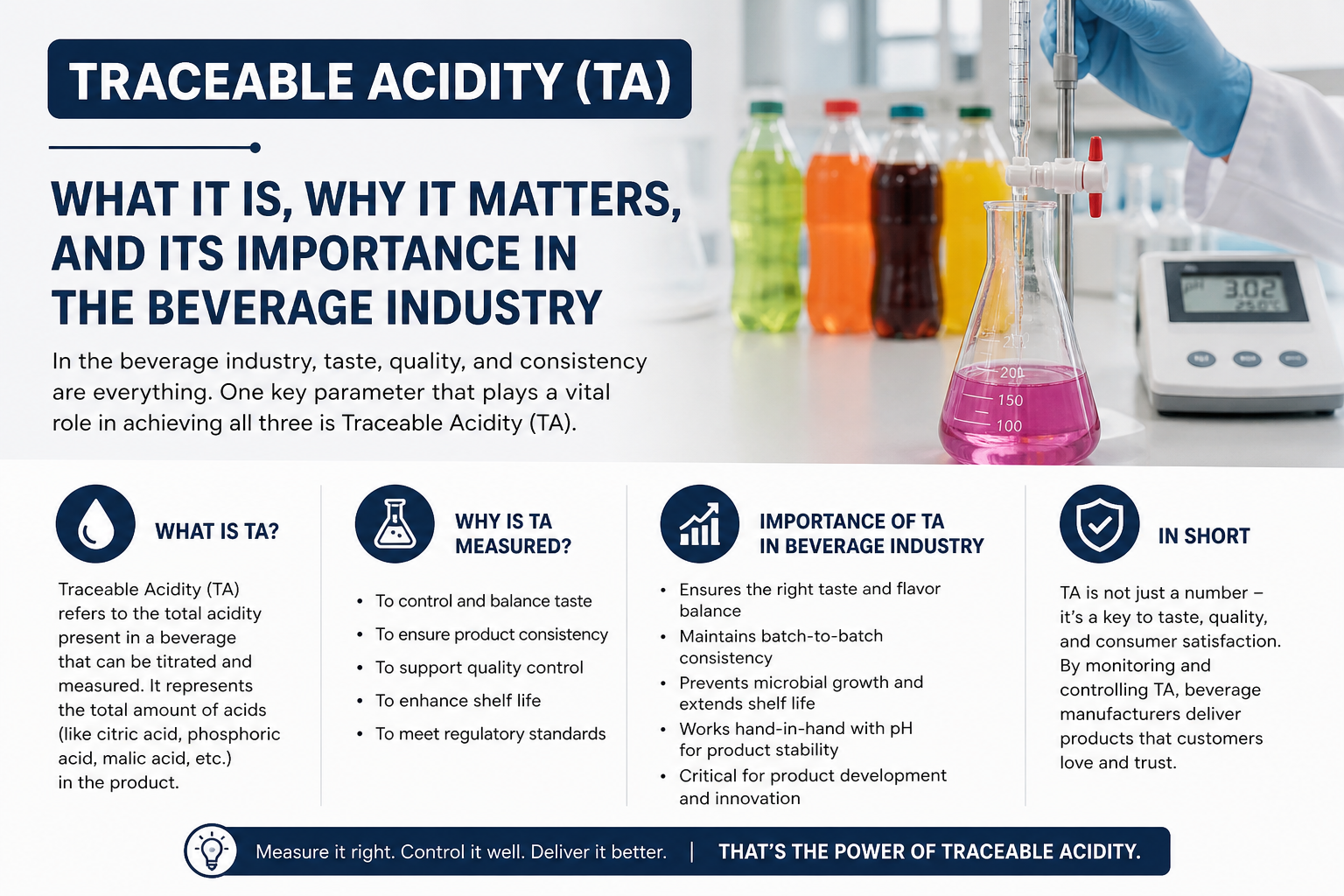
What is TitratableTitratable Acidity Acidity (TA)
Titratable Acidity (TA) refers to the total amount of acids present in a bever citric acid, phosphoric acid, etc.) that can be neutra base.
Unlike pH, which indicates the strength of acidity, TA represents the total quantity of acids in the product.
How is Titratable Acidity Measured
Titratable Acidity is measured using a titration method:
- A sample of the bOH) is added gradually
- The endpoint is reached when the solution becomes neutral
- The amount of base used determines the Titratable Acidity
The result is usually expressed as a percentage (%) or grams per liter (g/L), often in terms of citric acid.
Why is Titratable Acidity Measured
There are several important reasons for measuring Titratable Acidity in beverages:
- To control and balance taste (acidity level)
- To ensure product consistency between batches
- To maintain quality control standards
- To improve shelf life by limiting microbial growth
- To support research and product development
Importance of Titratable Acidity in the Beverage Industry
TA plays a critical role in beverage production:
- Helps maintain the right flavor balance (sweet vs sour)
- Ensures consistency from batch to batch
- Supports product safety and stability
- Works together with pH to control product quality
- Essential for innovation and new product development
pH vs TA (Key Difference)
- pH → Measures how strong the acidity is
- TA → Measures how much total acid is present
This is why two drinks can have the same pH but taste different
Consider a lemonade:
- pH tells you how acidic it is
- TA tells you how much total acid is in it
Conclusion
Titratable Acidity is not just a number—it is a key factor in determining taste, quality, and consistency in beverages. By properly controlling TA, manufacturers can deliver products that meet consumer expectations and maintain high standards.