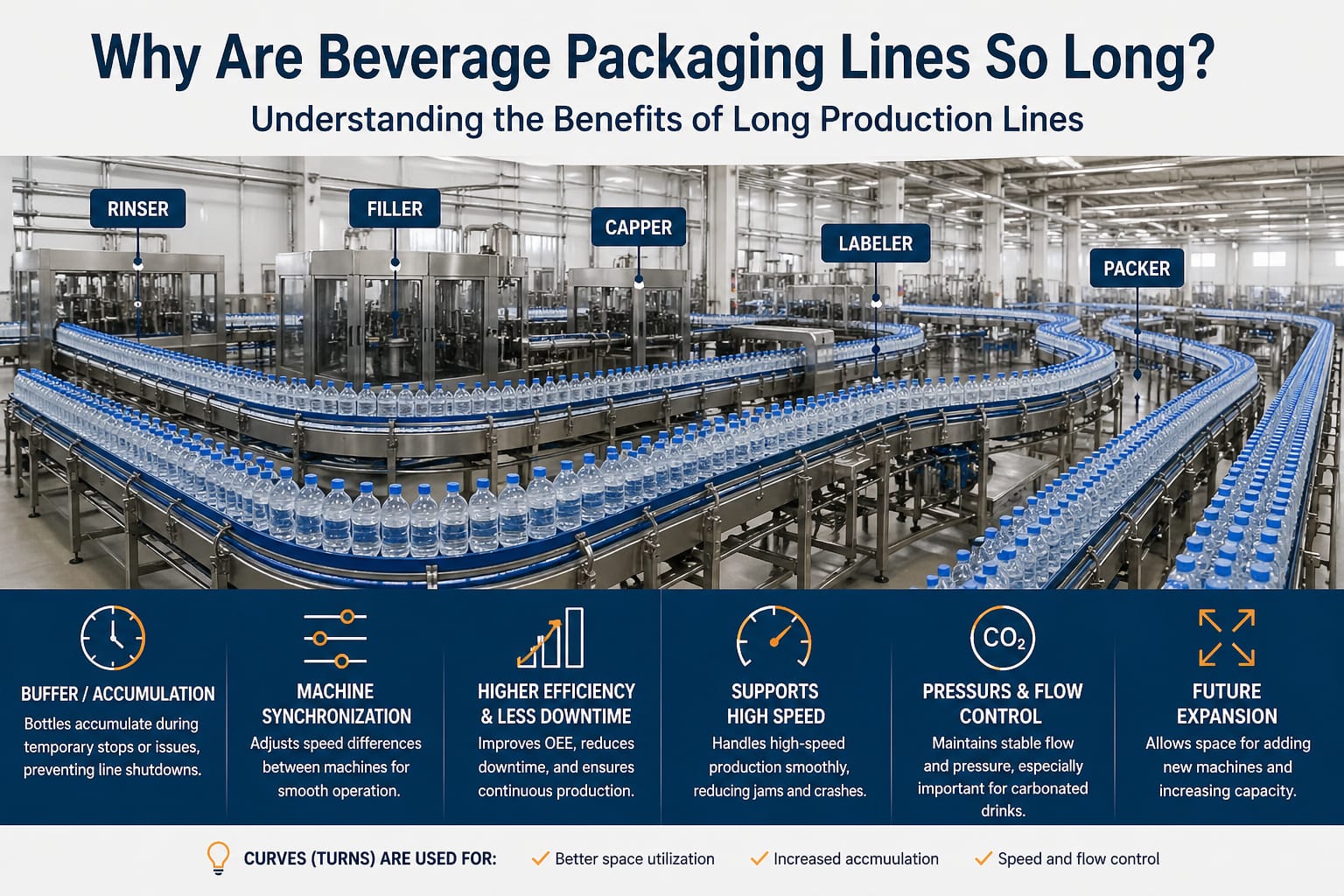
1. Buffer / Accumulation (Primary Reason)
In long production lines, extra space between bottles creates what’s called a buffer.
Benefit:
If the filler machine stops temporarily
Or there’s an issue with the packer or label. The entire line doesn’t shut down. Bottles can accumulate temporarily and keep the flow going.
If the line is too short:
- It will jam quickly
- The whole production stops immediately
2. Machine Synchronization (Line Balancing)
A typical packaging line includes multiple machines:
- Blowing
- Filler
- Capper
- Labeler
- Packer
These machines don’t always run at exactly the same speed.
With a longer line:
Speed differences are absorbed smoothly
Sudden stops/starts have less impact
3. Efficiency & Downtime Control
A longer line helps:
- Increase overall line efficiency
- Prevent full shutdowns due to minor faults
- Improve OEE (Overall Equipment Effectiveness)
4. High-Speed Production Support
Modern beverage plants operate at high speeds (e.g., 10,000+ bottles/hour).
If the line is short:
- It cannot handle high speed
- Bottles may crash or jam
With a long line:
- Flow remains smooth
- Production stays stable
5. Pressure & Flow Control (Especially for Carbonated Drinks)
For carbonated beverages, CO₂ pressure is critical.
If bottle flow is not smooth or stops suddenly:
- Foam can form
- Fill levels become inconsistent
- Gas loss may occur
A longer line ensures:
- Stable flow
- Better pressure control
6. Future Expansion
Companies design longer lines to:
- Add new machines later
- Increase production capacity when needed
7. Why Curves (Turns) Are Used
Curves in the line serve important purposes:
- Better space utilization
- Increased accumulation capacity
- Improved speed and flow control
Summary (Short Answer)
Although a short line can work, a longer line provides:
- Less downtime
- Higher efficiency
- Smoother production
- Reduced losses
- Better process control
In short: Long line = better performance and reliability.