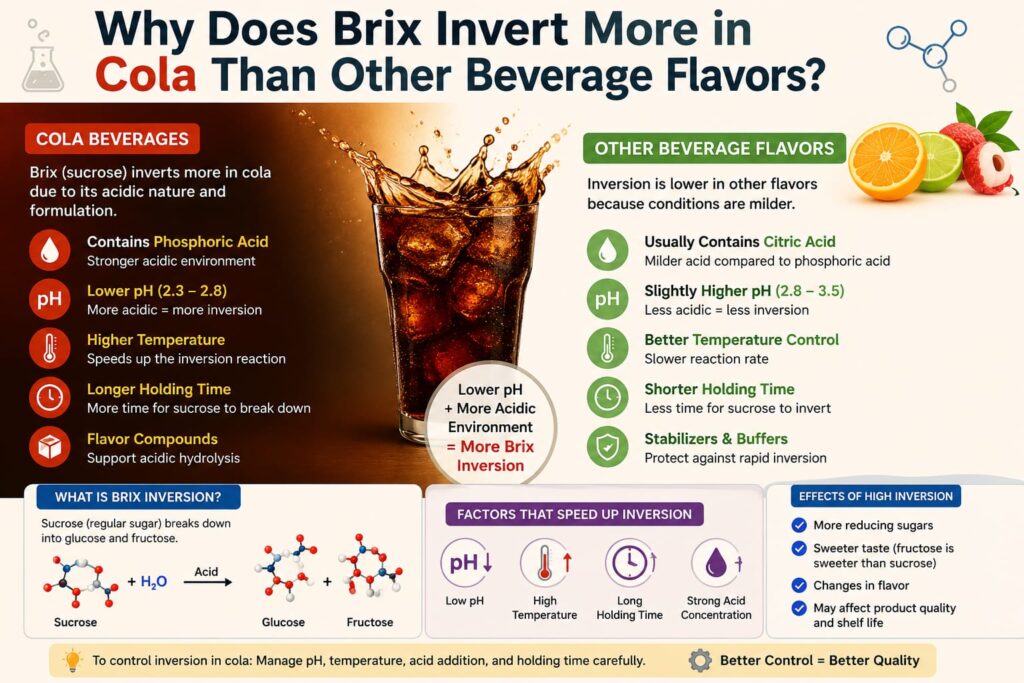
Brix Inverts More in Cola Than in Other Beverage Flavors
Brix inverts more in Cola than in other beverage flavors because of beverage chemistry, mainly due to the higher acidity and formulation of cola. Inversion means that sucrose (regular sugar) breaks down into glucose and fructose.
This reaction happens faster when:
- pH is very low (high acidity)
- Temperature is high
- Holding time is longer
- Acid concentration is stronger
Cola usually has all of these conditions, so inversion happens more easily.
Why does inversion happen more in cola?
Cola typically contains:
- Phosphoric acid (creates a stronger acidic reaction environment)
- Very low pH (around 2.3–2.8)
- Syrup may stay in holding tanks for some time
- Dark flavor compounds can support acidic reactions
Because of this, sucrose hydrolyzes faster and is converted into glucose and fructose, causing greater inversion.
Why does it happen less in other flavors?
Flavors like Orange, Lemon, Lychee, and Mango usually contain:
- Citric acid instead of phosphoric acid
- Slightly higher pH
- Some stabilizers that create a buffering effect
- Shorter holding time in some production systems
That is why inversion is usually lower compared to cola.
- Simple Example
If you prepare two syrups:
- Cola Syrup
pH = 2.4
Stored at 40°C for 24 hours
- Orange Syrup
pH = 3.2
Stored at the same temperature and time
The cola syrup will show more inversion because lower pH speeds up sucrose breakdown.
How is it identified in Quality Control?
You may notice:
- pH drops
- Taste becomes slightly sharper and sweeter (because fructose is sweeter)
- Reducing sugar tests confirm inversion in the lab
How beverage plants control inversion
- Keep syrup holding time short
- Control temperature carefully
- Add acid in the correct sequence
- Maintain proper syrup circulation
What Happens If Cola pH Is Increased to 3.2? Does It Reduce Brix Inversion?
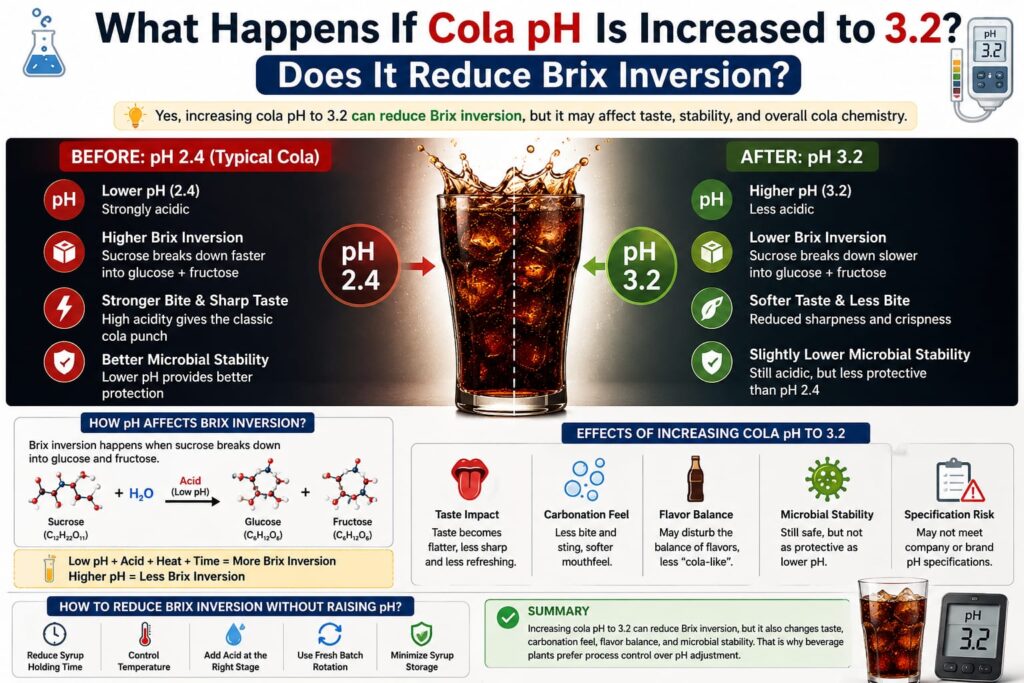
Theoretically, yes — if you increase cola’s pH from 2.4 to 3.1–3.2, sucrose inversion will decrease because acid hydrolysis becomes slower.
However, in commercial cola production, this is usually not a good solution, because changing the pH does not only reduce inversion — it also changes the entire cola chemistry and sensory profile.
Here are the possible effects:
- Taste Profile Will Change
- The sharp “bite” and crisp taste of cola mainly come from its low pH
If the pH is increased to 3.1–3.2, the taste may become:
- Flatter
- Less sharp
- Less refreshing
- The cola may lose its characteristic acidic punch
Carbonation Feel May Become Softer
- Low pH works with carbonic acid to create the strong sparkling “sting” in cola
- A higher pH can make carbonation feel softer and less aggressive
Microbial Stability Can Be Affected
- Low pH naturally helps prevent microbial growth
- Although pH 3.2 is still acidic, it is not as protective as pH 2.4–2.6
Flavor Balance May Be Disturbed
- Cola flavor oils, caramel notes, and phosphoric acid sharpness are designed to work within a specific pH range.
- Changing the pH may make the product taste less like real cola
Product Specifications May Fail
- Most beverage companies have strict pH specifications.
- If the approved range is 2.4–2.7, raising it to 3.2 could fail quality standards
How Beverage Plants Usually Reduce Inversion?
Instead of increasing pH, plants usually control inversion by:
- Reducing syrup holding time
- Controlling temperature carefully
- Adding acid at the correct stage
- Using fresh batch rotation
- Minimizing long syrup storage
How Sucrose Converts into Glucose and Fructose: The Chemistry of Sugar Inversion?
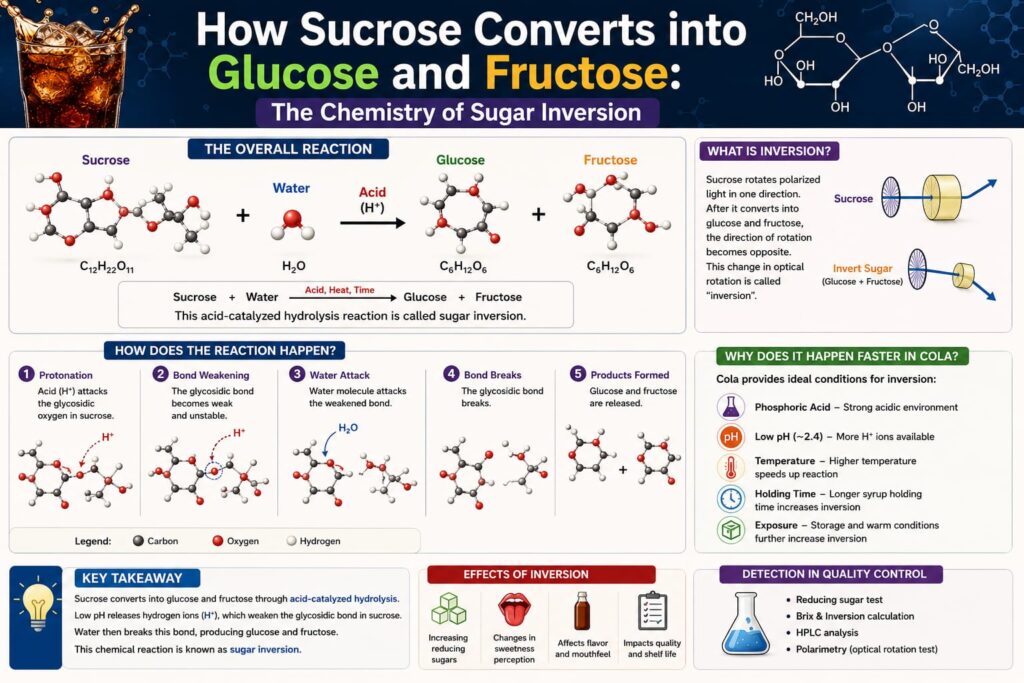
When we say that sucrose has inverted, it means the sucrose molecule has broken down into two simpler sugars:
- Glucose
- Fructose
This happens through a chemical reaction called Acid Hydrolysis.
In chemistry, hydrolysis means:
Breaking a chemical bond by adding water in the presence of an acid catalyst.
The chemical formula of sucrose is:
- C₁₂H₂₂O₁₁
When sucrose reacts with water (H₂O) under acidic conditions, it breaks into glucose and fructose:
- C₁₂H₂₂O₁₁ + H₂O → C₆H₁₂O₆ + C₆H₁₂O₆
This means:
Sucrose + Water → Glucose + Fructose
How Does This Reaction Happen?
Inside the sucrose molecule, glucose and fructose are connected by a special chemical bond called a:
- Glycosidic Bond
- Normally, this bond is stable.
However, when these conditions are present:
Very low pH
- Acidic environment
- High temperature
- Long holding time
The acid releases H⁺ (hydrogen ions).
These hydrogen ions attack the glycosidic bond and weaken it.
Then water breaks the weakened bond, splitting sucrose into:
- One glucose molecule
- One fructose molecule
This process is called sugar inversion.
Why Is It Called “Inversion”?
Sucrose rotates polarized light in one direction.
After it breaks into glucose and fructose, the direction of light rotation reverses.This reversal is called optical inversion, which is why the product is called invert sugar.
This is the scientific reason for the name.
Why Does This Reaction Happen Faster in Cola?
Cola usually contains:
- Phosphoric acid
- Very low pH (around 2.4)
- Syrup holding time
- Sometimes elevated temperature
These conditions speed up acid hydrolysis.
That is why sucrose converts into glucose and fructose faster in cola
How Is It Detected in Quality Control?
When inversion increases:
- Reducing sugar level increases
- Sweetness perception changes
- Syrup behavior may change
- Lab tests show measurable differences